When buying running shoes, it’s common to look at cushioning, weight, brand, design or foot strike type. However, there’s one technical detail that can have a significant impact on how you feel whilst running: the drop.
The drop of a running shoe can affect the way you land your foot, the transition of your stride and the strain placed on muscles such as the calves, soleus or Achilles tendon. Therefore, understanding what it means and how to choose it will help you find shoes that are better suited to your running style.
What is the drop in running shoes ?
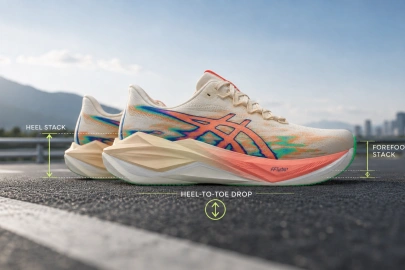
The drop is the difference in height between the heel area and the front of the shoe, where the metatarsals rest.
Put simply: it indicates how many millimetres higher the heel is compared to the forefoot.
For example, if a shoe has:
35 mm heel height.
27 mm forefoot height.
Its drop will be 8 mm.
In other words: 35 mm - 27 mm = 8 mm drop
In the image below, we can see the difference between the heel stack (heel height), the forefoot stack (forefoot height), and the heel-to-toe drop, which is the difference between the two points.
Drop and cushioning are not the same
One of the most common misconceptions is to think that a shoe with a high drop always has plenty of cushioning, or that a shoe with a low drop is necessarily minimalist. This is not the case.
The drop refers to the angle between the heel and the forefoot.
Cushioning refers to the type of foam used in the shoe; it can be a more cushioned EVA type or a more responsive PEBA type.
That is why we can find different combinations:
- A shoe with a high drop and little cushioning.
- A shoe with a low drop and plenty of cushioning.
- A shoe with a medium drop and high cushioning.
- A shoe with zero drop and a maximalist design.
The drop does not measure how soft, protective or responsive a shoe is. It simply indicates the difference in height between the rear and front.
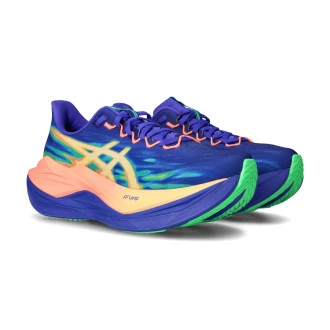
A good example is the ASICS Superblast 3, a shoe with an 8 mm drop, high cushioning and a construction designed for fast training on tarmac. In other words, it combines a medium drop with a voluminous and responsive midsole.
Types of drop in running shoes
Although different brands may use different measurements, we can generally classify heel-to-toe drop into three main categories: high drop, medium drop and low drop.
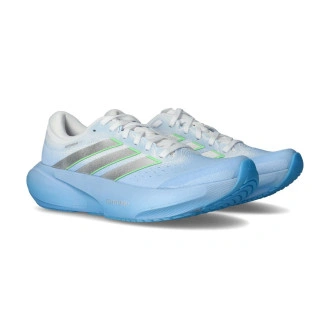
High drop: approximately 9–12 mm
High-drop shoes typically have a marked difference in height between the heel and forefoot. Traditionally, many running shoes designed for daily training have featured this type of drop.
They are often a good choice for heel-strikers, those looking for a smooth transition, or runners who prefer a more traditional feel when running.
They can also be well suited to easy runs, long-distance training or for beginner runners who are still building up their technique, strength and mileage.
This doesn’t mean they are better or worse: they simply offer a more favourable design for those who feel comfortable with a higher heel.
Medium drop: approximately 5-8 mm
The mid-drop is one of the most versatile options in modern running. It offers an interesting balance between comfort, transition and a natural feel.
This range tends to work well for many types of runners: those who train daily, those who combine long runs with interval training, those preparing for 10K, half-marathon or marathon races, and those looking for comfortable trainers without excessive heel-to-toe drop.
An 8 mm drop, such as that of the ASICS Superblast 3, is a good example of this mid-range. It provides a cushioned feel without being too high.

Low drop: approximately 0-4 mm
Low-drop shoes significantly reduce the height difference between the heel and the forefoot. This can encourage a forefoot or midfoot strike, but it also requires greater muscular adaptation.
With a low drop, areas such as the calves, soleus, feet and Achilles tendon may have to work harder. For this reason, it is not usually advisable to switch abruptly from a high-drop shoe to a low-drop one.
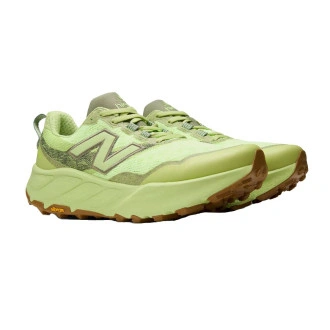
This type of drop may be suitable for runners with good technique, experience, strength training and a gradual adaptation. It is also common in natural running, barefoot or some trail running shoes.
How does the drop affect your running style?
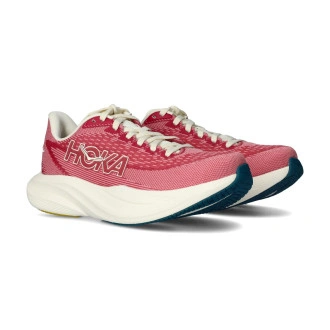
The drop doesn’t completely change your technique, but it can influence how you feel and the distribution of load during your run.
A shoe with a high drop can make heel strike more comfortable and reduce the strain on the posterior muscle chain, particularly the calves and soleus.
A shoe with a low drop may encourage a forefoot strike, but it also increases the muscular demand on the back of the leg.
A shoe with a medium drop usually offers a good balance for many runners, as it allows for a smooth transition without requiring such a radical adjustment.
The important thing is to understand that there is no one-size-fits-all drop. The best drop will be the one that suits your running technique, your injury history, your strength levels, your pace and how you feel when running.
Which drop should you choose based on your running style?
Beginners
If you’re a beginner, it’s usually best to choose shoes that are comfortable, stable and easy to get used to. In this case, a medium or high heel-to-toe drop is usually a safe bet.
It’s not a good idea to get too hung up on very low heel-to-toe drops at the start. Before aiming for a more ‘natural’ stride, it’s better to build a solid foundation: run regularly, improve your technique gradually, strengthen your legs and feet, and avoid sudden changes.
To start with, look for running shoes with good cushioning, a comfortable fit and a smooth transition.
Long distance runners
For long runs, half marathons or marathons, many runners find a heel-to-toe drop of between 6 and 10 mm comfortable.
This range offers a balance of protection, comfort and efficiency. Over long distances, muscle fatigue is inevitable, so a shoe with a balanced drop can help you maintain a more stable stride for longer distances.
Other important factors also come into play here: cushioning, weight, base width, stability and midsole responsiveness.
Whether you do sets, interval training or high-intensity training
For fast workouts, intervals or high-intensity runs, many runners look for lighter, more responsive shoes with a quick transition.
In these cases, the heel-to-toe drop can vary considerably depending on the model. There are fast shoes with low, medium or even high drops. The most important thing is that the whole package works: geometry, foam, stiffness, rocker, weight and fit.
The ASICS Superblast 3 is an interesting example among fast training shoes for road running. Its 8 mm drop, high cushioning and responsive midsole make it a versatile option for runners who want to train with protection, but also with responsiveness.
If you're recovering from an injury or are experiencing discomfort
If you have experienced discomfort in your calves, soleus, Achilles tendon, plantar fascia, knee or hip, you should not make a drastic change to the heel-to-toe drop without a gradual adjustment.
For example, switching from a 12 mm heel-to-toe drop shoe to a 0 mm one all at once can place too much strain on areas that are not yet prepared.
In these cases, the wisest course of action is usually to stick with a drop similar to the one that already works for you and, if you want to change, do so gradually. If you have an active injury or recurring pain, it is advisable to consult a specialist.
Trail runners
In trail running, the drop is also important, but it isn’t the only decisive factor. In the mountains, other aspects come into play, such as stability, protection, grip, distance, elevation gain and the type of terrain.
A low drop can provide a greater sense of contact with the ground, but it also requires more strength and technique. A medium or high drop may be more comfortable on long runs or less technical terrain.
When choosing trail running shoes, in addition to the drop, it is worth looking at the sole, the lugs, the toe protection, lateral stability and the fit of the upper.
Common mistakes when choosing the drop
To think that a lower drop is always better
A low drop doesn’t automatically make you a better runner. It can help you develop a more active stride, but it can also increase the strain on your muscles if you’re not prepared.
Running technique doesn’t depend solely on your shoes. Strength, mobility, cadence, posture, fatigue and experience all play a part.
Changing drops too quickly
This is one of the most common mistakes. If you’ve been running in high-drop shoes for years, it’s not a good idea to switch straight to minimalist or zero-drop shoes.
Your body needs time to adapt. Your tissues, muscles and tendons respond better to gradual changes.
Confusing drop with midsole height
A running shoe may look very high, yet still have a low or medium heel-to-toe drop. It is not the overall height that determines the drop, but the difference between the heel and the forefoot.
That is why, before buying a pair of running shoes, it is a good idea to check the technical specifications and not be guided solely by appearance.
Choosing purely for the sake of fashion
Every season brings new trends: maximalist shoes, models with a midsole plate, low drops, high drops, bold geometric designs or more natural styles. But the most important thing is still how well the shoe suits you.
The best shoe isn’t the one that’s in fashion, but the one that suits your running style.
|
| Recommended for | ||||
| Low | 0-4 mm | Technical runners, natural transition, experience and good muscle adaptation | ||||
| Medium | 5-8 mm | Daily training sessions, varied paces, runners seeking balance | ||||
| High | 9-12 mm | Beginners, heel-strikers, comfortable runs and long distances |
How to change drops safely
If you want to try a different heel-to-toe drop, it’s best to do so gradually.
Start by wearing your new shoes on short, gentle runs. Alternate between them and your usual shoes during the first few weeks. Avoid wearing them for the first time on a long run, a race or a demanding training session.
It’s also a good idea to include strength exercises for your feet, calves, soleus and glutes. The better prepared your muscles are, the easier it will be to adapt to different shoe geometries.
And, above all, listen to how you feel. A little discomfort is normal when switching shoes, but persistent pain shouldn’t be ignored.
Practical example: ASICS Superblast 3 with an 8 mm heel-to-toe drop
The ASICS Superblast 3 is a good example of a shoe with a mid-drop of 8 mm.
It is designed for runners looking for a feeling of maximum energy underfoot, with high cushioning and a responsive midsole. It is a shoe geared towards fast training sessions on tarmac, but with enough protection to rack up the miles in comfort.
Its 8 mm heel-to-toe drop makes it a balanced option: it isn’t a radically low-profile shoe, but it doesn’t have an excessive drop either. That’s why it’s a good fit for runners who want a versatile, lightweight and responsive shoe for lively training sessions.
What’s more, its combination of cushioning, lightness and rebound makes it an attractive option for those looking for a premium training shoe capable of performing well on both long runs and at a faster pace.
There’s no such thing as the perfect drop; there’s only the right drop for you
The drop is one of the most important factors in running shoes, but it shouldn’t be considered in isolation. It refers to the difference in height between the heel and the forefoot, and can influence your foot strike, how the shoes feel, and the strain on your muscles whilst running.
A high drop can be comfortable and supportive. A medium drop can offer balance and versatility. A low drop can provide a more natural feel, but requires more time to adapt to.
The key is to choose based on your experience, technique, goals and the type of training you’ll be doing.
At Running Emotion, you can find running shoes with different drops, from models for beginners to shoes for daily training, fast training, competition or trail running. And if you’re looking for a balanced, responsive option with high cushioning, the ASICS Superblast 3 with an 8 mm drop is a great example of a versatile shoe for running on tarmac.