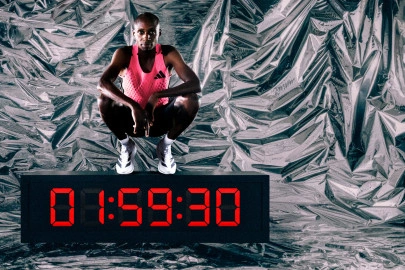
The 2026 London Marathon was not just a great race; it was a turning point in the history of running. In conditions perfect for a fast run, Sabastian Sawe achieved what had seemed unattainable for years: clocking a time of 1:59:30 in an official competition.
This time not only breaks the two-hour barrier, but confirms that sub-2h is no longer an isolated experiment like Eliud Kipchoge’s in the INEOS 1:59 Challenge, but has become a competitive reality.
A marathon that pushes the boundaries
The scale of what happened in London is best understood by looking at the key statistics from the race:
- An average pace of around 2:49 min/km
- The second half of the marathon completed in under 60 minutes
- Several athletes finishing under the former world record
Meanwhile, the women’s race also produced a historic performance. Tigst Assefa once again demonstrated her dominance by setting a new women’s record, cementing her status as the undisputed benchmark in world marathon running.
Two legendary performances on the same day that share a key element: the evolution of running shoes.
The role of running shoes in performance
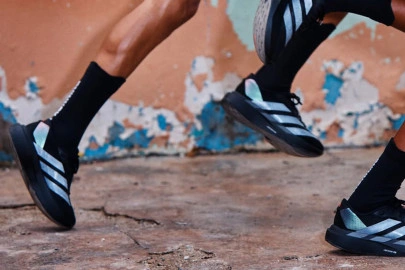
In Sawe’s case, as is often the case with elite athletes, the exact model has not been publicly confirmed. However, all the evidence points to a state-of-the-art prototype designed to maximise efficiency at extreme paces, which adidas marketed as the Adizero Pro Evo 3.
These shoes share some very distinct features:
- Carbon plate to improve propulsion
- Ultra-lightweight foams with high energy return
- Extremely low weight
- Optimised geometry for a faster transition
Designed for race day, the Adizero Adios Pro Evo 3 is the result of three years of intensive research by Adidas. They have managed to make them 30% lighter than the previous version of the shoe, offering 11% more energy return in the forefoot and improving running economy by 1.6% compared to their predecessor. But how have they managed to make them so light? First of all, I must confess that, although I haven’t been able to run in them, I have been able to hold them in my hands, and whilst I was already blown away by the other two versions, I’m even more so by these. You can barely feel those 97.27 grams (in men’s size 42).
But at the heart of these Pro Evo 3s lies the new Energyrim technology, leaving the familiar EnergyRods behind. An innovative full-length carbon fibre plate supports the bulk of the foam, whilst providing precisely tuned stiffness to ensure stability. It is this unique combination of foam and carbon that ensures energy return, propulsion and efficiency make the Adizero Adios Pro Evo 3 a super shoe.
The ‘super shoes’ revolution
What happened in London is no coincidence. Technology applied to footwear has changed the way we run, enabling athletes to:
- Maintain higher paces for longer
- Reduce muscle fatigue
- Improve efficiency with every stride
This explains why we have seen a cascade of records in recent years.
But what is really interesting is that this technology is no longer reserved for the elite. Today, any runner can access models directly inspired by these shoes.
Options for amateur runners
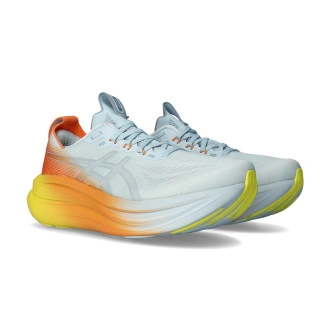
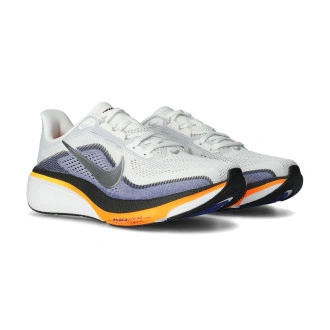
If you’re looking to bring some of that performance into your everyday life, here are some of the best options currently available at Running Emotion.
For those who want to compete at the highest level, there are models that replicate the sensations experienced by elite athletes:
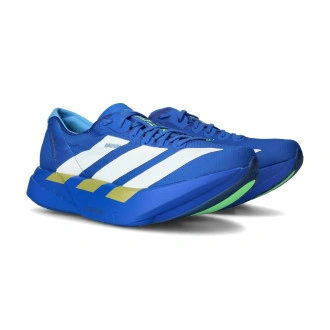
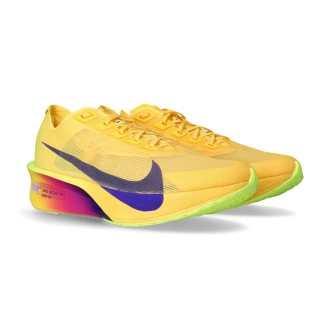
These shoes are designed for competition, achieving personal bests and maximising performance over long distances.
If your goal is to improve but you need something more versatile, there are models that strike a balance between performance and training:
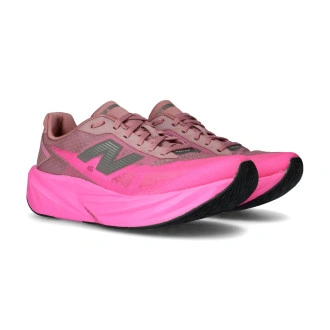
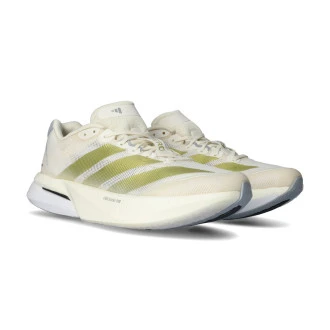
They are ideal for high-quality training sessions, interval training or one-off competitions.
And, of course, the foundation of any improvement still lies in daily training. To clock up the miles safely, these trainers remain essential:
Another key factor: nutrition
Beyond running shoes, there is one element that is making a real difference in modern running: nutritional strategy during the race. In events such as the London Marathon, elite athletes don’t just run fast; they are constantly fuelling their bodies to maintain that pace.
During the race, the objective is clear:
- Maintain stable energy levels
- Avoid the dreaded ‘hitting the wall’
- Optimise carbohydrate absorption
This translates into very specific strategies such as the frequent intake of energy gels combined with carbohydrate drinks to improve the absorption of different types of sugars and nutrients. In many cases, elite runners are consuming between 60 and 90 grams of carbohydrates per hour, something unthinkable just a few years ago.
This evolution in nutrition is just as important as footwear technology. Without that constant energy supply, maintaining paces close to 2:50/km for more than two hours would be practically impossible.
Running faster is closer than ever
What we saw in London with Sabastian Sawe and Tigst Assefa confirms one thing: running has entered a new era. Today, performance depends not only on training, but also on the technology you wear on your feet.
And the best part is that this technology is now within reach of every runner.
Discover the shoes inspired by elite athletes at Running Emotion and find the model that best suits your goals. Run faster. Run better. Enjoy every kilometre.